
Murphy’s Close Call with a Car
Two-year-old Cockerpoo, Murphy, was sadly hit by a car on the afternoon of November 20th, 2025. His owners rushed him to Advanced Vetcare London's Streatham Hill sister-location, where he presented with multiple life-threatening injuries. His case demonstrates the complexity of trauma management and the critical importance of prioritisation when faced with numerous severe injuries.
Murphy’s Presentation
Road traffic accidents create a devastating pattern of injuries. The force of impact, combined with the twisting and compression that occurs when struck by a vehicle at speed damages multiple body systems simultaneously. For Murphy, the collision resulted in catastrophic pelvic injuries, a dislocated hip and a life-threatening abdominal hernia.
When Murphy arrived, he was lying on his side, unable to stand and clearly in severe pain. His physical examination revealed extensive bruising across his hind limbs and his abdomen - visible evidence of what we expected to be significant internal trauma beneath. He had burns on both thighs and his left hind paw, likely from contact with the road surface. A small open wound marked where the skin had broken during impact.
.jpeg)
Blood tests showed his body was struggling to cope with the trauma. His kidney markers were elevated (BUN at 9.5 mmol/l, above the normal range of 2.5-8.9) and his liver enzymes were high (ALT at 148 UI/L significantly higher than a normal range between 10-118), indicating his organs were under stress. Fortunately, his blood cell counts remained normal.
Murphy immediately received pain relief and intravenous fluid therapy to combat shock while the team performed emergency imaging.
What We Found
The chest X-rays brought some relief, revealing no lung damage or bleeding in the chest cavity, which was fortunate given the severity of the accident.
However, the abdominal and pelvic imaging revealed the full extent of Murphy's injuries.
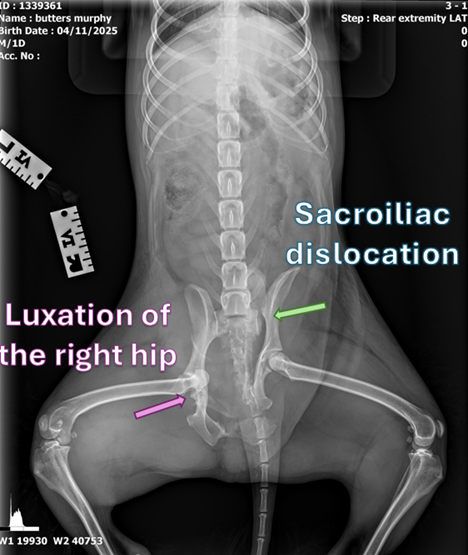
Both pubic bones were fractured on both sides. Murphy's intestines had pushed through a tear in his abdominal wall where the prepubic ligament (a strong band of tissue anchoring the abdominal muscles to the pelvis) had completely ruptured. The bladder's position was unclear on X-rays. This was particularly concerning because a bladder rupture can be fatal.
Murphy’s left sacroiliac joint (where the pelvis connects to the spine) was completely dislocated. His right hip was also dislocated, with the ball of the femur sitting in an abnormal position (upward and forward).
The team attempted to manually relocate Murphy's hip, but the severity of his injuries meant that the femoral head wouldn't stay in its socket and immediately dislocated again.
Emergency Surgery: A Staged Approach
With multiple life-threatening injuries, the surgical team faced critical decisions about which injuries to focus on first. In trauma cases like Murphy's, attempting to fix everything at once can be as dangerous as doing too little. Our team developed a strategic plan: address the life-threatening abdominal emergency immediately, provide stability and comfort where possible, then tackle the remaining injuries once Murphy had stabilised.
Stage One: Saving Murphy's Life - The Abdominal Repair
On the same afternoon as the accident, the surgical team performed emergency surgery to repair Murphy's ventral abdominal hernia. With his intestines and bladder sitting outside the normal abdominal cavity, this couldn't wait and delay risked serious complications.
What We Found Inside
Through an incision along the lower abdomen, the team were able to assess the full extent of the damage. Murphy’s bladder had herniated through the tear but thankfully was intact This was excellent news. The ureters (tubes from kidneys to bladder) were also undamaged.
The fractures had broken the pubic bones in multiple places on both sides causing Murphy’s abdominal muscles to completely detach from their pelvic attachments on both sides. Essentially, the front of Murphy's abdominal wall had detached from the pelvis.
The Repair
With the pubic bones fractured and unstable, the team couldn't simply reattach the muscles to their original position. Instead, they used an alternative anchoring technique - suturing the abdominal muscles to the inner thigh muscles using strong dissolvable sutures. Essentially this created a new attachment point where the original one was too damaged to use.
Providing Immediate Comfort
Murphy remained stable under anaesthesia, giving the surgical team an opportunity to address one more injury before waking him. While we couldn't safely perform all necessary procedures in a single surgery, stabilising the joint connecting the pelvis to the spine would provide significant comfort during the crucial first days of recovery.
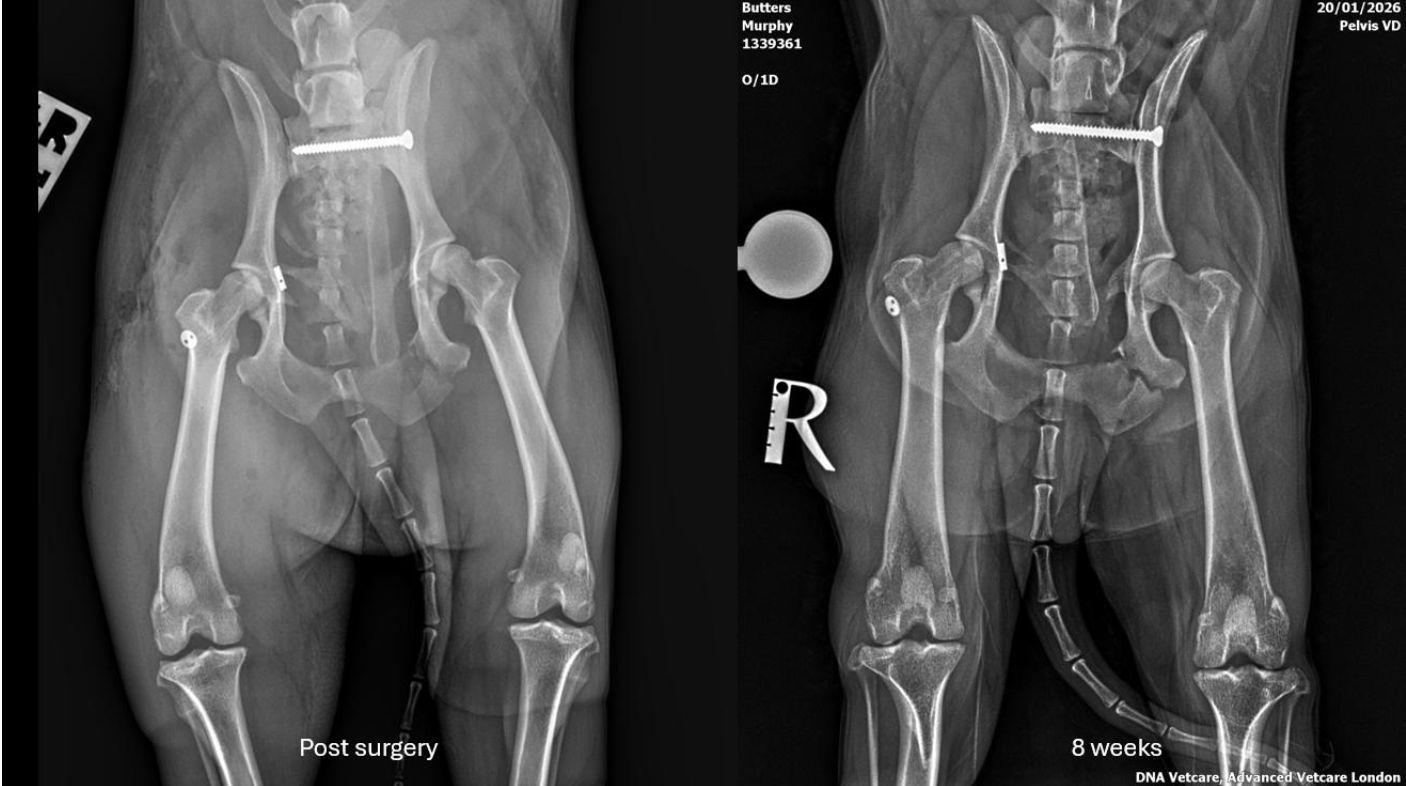
Starting at the top, the team repositioned the dislocated sacroiliac joint and secured it with a screw - a technique that compresses the joint surfaces together as the screw tightens, providing maximum stability. Murphy recovered well from anaesthesia and was transferred to intensive care.
The Critical Recovery Period
Following emergency surgery, Murphy faced a precarious recovery phase. Multiple trauma patients remain at risk for serious complications as the full extent of tissue damage becomes apparent over days and weeks.
Murphy stayed in our intensive care facility where we could closely monitor him. We gave him continuous intravenous fluid therapy to support his circulation and kidney function. He also received a combination of pain medications including strong opioids and anti-inflammatories.
Over the following days, Murphy showed gradual improvements. By the fifth day post-accident, he was stable enough for the next surgical stage.

Stage Two: Repairing the Hip
Five days after the accident we were able to address Murphy’s hip dislocation.
Hip dislocations are classified by which direction the femoral head (ball) has moved from the socket. Murphy's was a craniodorsal luxation (upward and forward) - the most common type. Examination under anaesthesia revealed a type C joint capsule tear, meaning the fibrous capsule surrounding the hip had torn extensively.
The Surgical Approach
The team made an incision to directly access the joint and manually repositioned the femoral head back into the hip socket. To keep it there, we used two complementary techniques:
A toggle (similar to a large button) was placed inside the pelvis, anchored through a tunnel drilled in the bone. Heavy-duty suture material ran from this internal anchor, through a hole drilled in the femoral head, creating an artificial synthetic version of the ligament that
Murphy recovered smoothly from this second anaesthetic and stayed overnight for additional pain relief.
%20(1).jpeg)
A Remarkable Turning Point
The day after his hip surgery, marked a dramatic improvement. Murphy was able to take a few steps for the first time since his accident. While he still had significant bruising and swelling in his hind limbs, he was comfortable and showing clear improvements. The wound on his right hind paw was also beginning to show healthy granulation tissue - the pink tissue that forms during normal wound healing.
Murphy was discharged home that evening - just six days after arriving at death's door.
Murphy's Recovery
Road traffic accident recovery is measured in months, not days or weeks. Murphy went home with a comprehensive management plan and careful monitoring protocols.
As well as a medication schedule to keep Murphy comfortable and pain free as he healed, his owners were advised to closely monitor his wounds, which involved daily bandage changes, as well as delivering gentle massage on Murphy’s hind limbs to reduce swelling and bruising.
Murphy was on strictly reduced exercise for at least 10 weeks, with no running, jumping or unsupervised activity to allow his injuries to heal fully.
What This Case Teaches Us
Murphy's case exemplifies several critical aspects of trauma management that apply to both veterinary professionals and pet owners understanding their pet's care.
A staged, carefully prioritised approach to Murphy’s case was critical. Not every injury requires immediate attention. The team addressed the most life-threatening injuries first and focused on stabilisation and comfort before moving onto Murphy’s other injuries. Attempting to fix everything in one marathon surgery would have been extremely dangerous. Spacing procedures over several days allowed Murphy's body to recover between anaesthetics and gave the team time to assess his progress at each stage.
For pet owners, Murphy's story highlights why addressing trauma promptly matters. The rapid intervention - emergency surgery on the same day as the accident - was crucial to his survival. Delay with injuries this severe can mean the difference between recovery and loss.
What's Next for Murphy?
Murphy's prognosis is cautiously optimistic. Walking just six days after such devastating injuries is remarkably encouraging. However, the true test comes over the following weeks and months as fractures heal, the toggle stabilises and extensive soft tissue damage resolves.
With appropriate rest, careful monitoring, and the dedicated care of his owners, Murphy has excellent chances of returning to a good quality of life. Some dogs with pelvic trauma do develop long-term complications like arthritis or altered gait, but many recover remarkably well.
This case exemplifies Advanced Vetcare London's commitment to advanced surgical techniques, comprehensive trauma management, and the clinical judgment required to navigate complex multi-system injuries. When prioritisation, timing, and expertise align, even the most devastating injuries can have positive outcomes.