
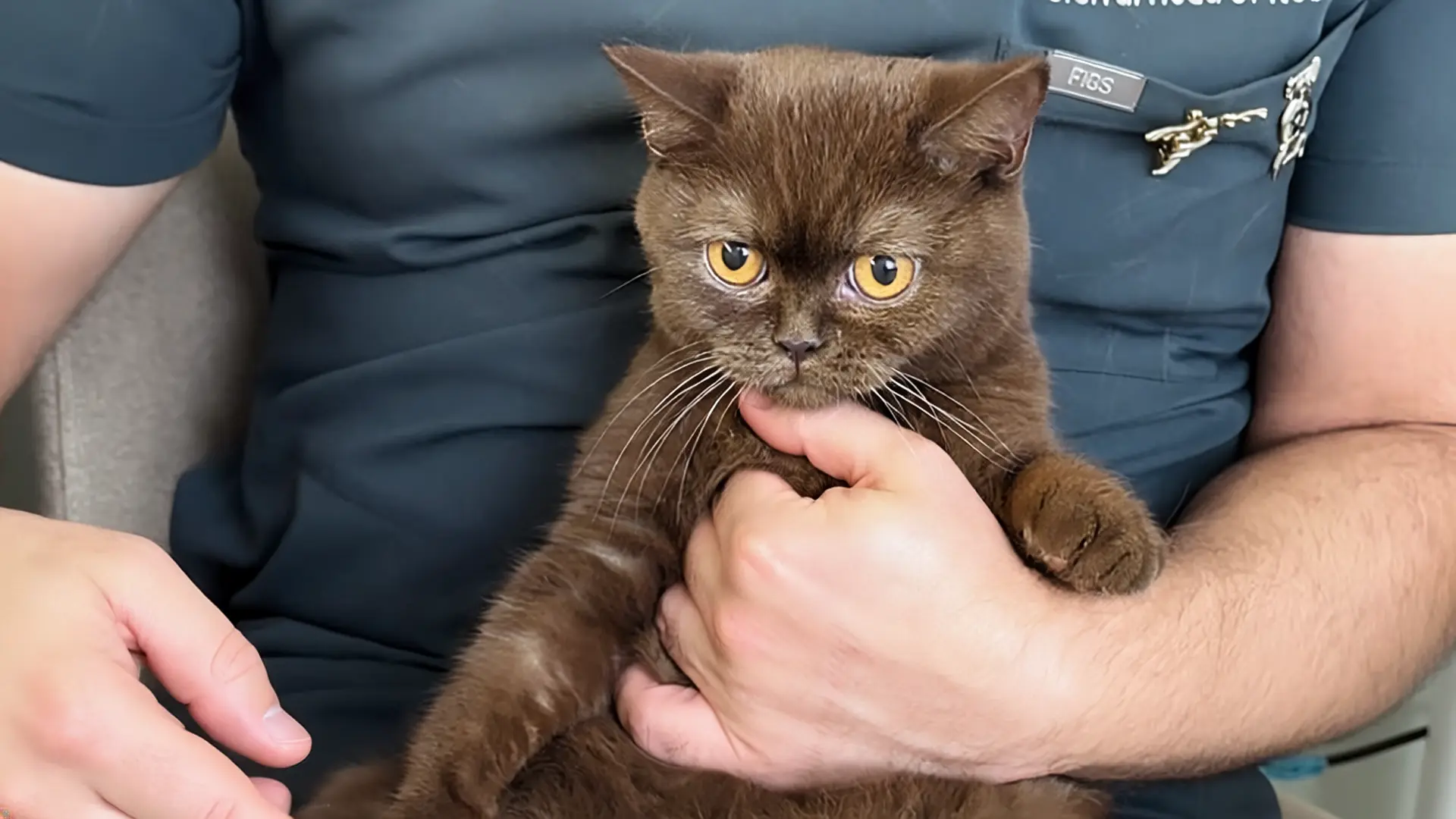
Here at Advanced Vetcare London, we recently treated Bonnie, a beautiful young British Shorthair kitten who was referred to our Neurology and Neurosurgery Service after she started showing signs of weakness that appeared to be getting progressively worse.
When Bonnie first came to us, there was concern that the problem could be affecting her spinal cord, particularly given the possibility of a previous traumatic event.
Her initial neurological examination supported this suspicion, but it was not possible to rule out an early neuromuscular condition, such as polyneuropathy.
As neurological conditions can evolve over time, Bonnie was carefully monitored and brought back for a repeat examination. This follow-up assessment proved particularly important in helping us understand what was really going on.
Finding the Problem
When Bonnie returned a week later, her neurological examination had changed significantly.
She was no longer able to walk normally and had weakness affecting all four limbs. She had a plantigrade stance, meaning she was standing with her paws and ankles in an abnormal position, and at times she held her neck in a lowered position.
We also found that the normal spinal reflexes in her legs were significantly reduced, particularly in her back legs. This gave us an important clue that the problem was affecting the nerves that control her movement.
These findings shifted our suspicion towards a neuromuscular disorder called polyneuropathy.
Investigating the Cause
Bonnie had already undergone an extensive investigation.
Blood tests, including checks of Bonnie’s blood cells, organ function and electrolytes, were all within normal limits. Tests for FIV and FeLV were also negative.
We also analysed a sample of cerebrospinal fluid (CSF), the fluid that surrounds the brain and spinal cord. This showed no signs of inflammation or infection, and further testing for infectious diseases, including toxoplasmosis and FIP, was negative. The results did not strongly support inflammation of the spinal cord, such as myelitis, as the cause of Bonnie’s signs.
After reviewing all the findings, we felt that polyneuropathy was the most likely explanation for Bonnie’s weakness.
Understanding Polyneuropathy
Polyneuropathy is a condition that affects the peripheral nerves, which are responsible for carrying messages between the brain and spinal cord and the rest of the body. When these nerves are affected, the muscles do not receive the signals they need to work normally.
In Bonnie’s case, this caused weakness in all four legs, difficulty walking and an abnormal stance. Cats with polyneuropathy can also have reduced reflexes, become tired more easily and, in more severe cases, may struggle to stand or walk.
Bonnie was suspected to have a rare inherited motor axonal polyneuropathy.
This condition has been reported in young British Shorthair cats, suggesting that some cats of this breed may be predisposed to it. Signs can develop when cats are still kittens, although the age at which they appear can vary.
There is currently no specific treatment that can directly repair the affected nerves. Instead, treatment focuses on supporting the cat while the nerves recover. This can include physiotherapy to help maintain muscle strength and movement, making adjustments to the home environment to help the cat move around safely, and monitoring closely for any changes.
Some cats can remain stable for a long time, while others may gradually become weaker.
Encouragingly, some young cats can make a full recovery, as Bonnie did. In some cases, however, signs can return later in life, so ongoing awareness and monitoring are important.
Bonnie’s Treatment and Recovery
In Bonnie’s case, corticosteroid treatment was started in an attempt to reduce any potential inflammation affecting the nerves, alongside a programme of physiotherapy.
The next few weeks brought some very encouraging news.
When Bonnie returned for her follow-up examination, her owners reported a great improvement. She had completed her corticosteroid and physiotherapy programme and, remarkably, was now back to normal.
On examination, Bonnie was bright and alert. She was walking normally with a steady gait, and her postural reactions and spinal reflexes were intact. There was no evidence of spinal pain, and her cranial nerve examination was also normal.
We’re delighted to report that Bonnie was signed off with a full clinical recovery and is now back to her normal self. While occasional relapses can occur with this condition, her owners have been advised to contact our team if they notice any signs of weakness returning.
For now, Bonnie is back to doing what a young kitten should be doing and simply getting on with being a kitten!
What Bonnie’s Case Teaches Us
Bonnie’s recovery is a fantastic outcome, but her case highlights an important point in veterinary neurology. The first examination does not always tell the whole story.
Neurological conditions can evolve quickly, particularly in young animals, and signs that are not obvious initially can become much clearer over time.
In Bonnie’s case, her repeat neurological examination revealed changes that helped our team identify that the problem was more likely affecting her peripheral nerves rather than her spinal cord.
By combining her repeat examination with the MRI, blood tests and CSF results, we were able to build a clearer picture of her condition and provide the appropriate supportive treatment.
Thankfully, Bonnie responded very well and went on to make an excellent recovery!